
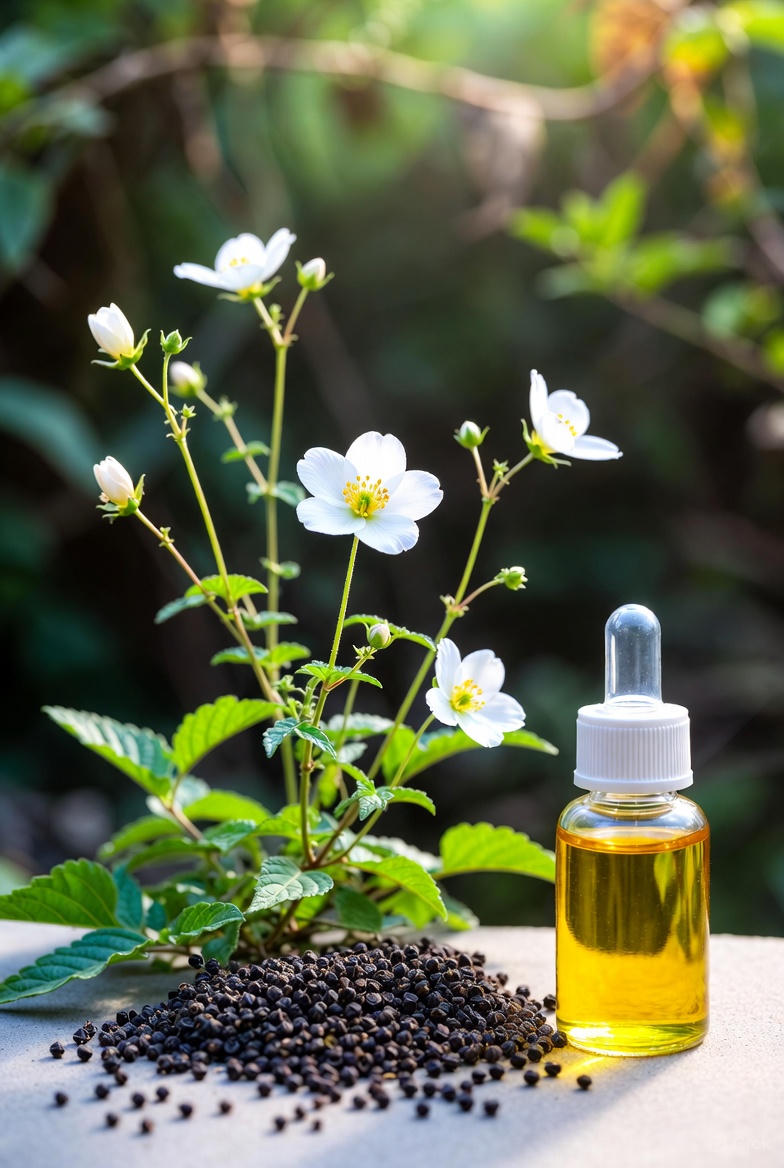
Habatusawda (Biji Hitam / al-Ḥabbah al-Sawdā’, Shūniz)
Keluarga: Ranunculaceae
Nama Botani: Nigella sativa
Nama Biasa: Bahasa Inggeris: Black seed, black cumin, common fennel flower, Roman coriander, nutmeg flower, fitches; Bahasa Perancis: Nigelle, Nielle, Cumin noir; Bahasa Sepanyol: Ajenuz, Comino negro, Falso comino; Bahasa Jerman: Echter Schwarzkümmel; Urdu/Unani: Kalonji, Shoneez; Bahasa Arab Standard Moden: Ḥabbah al-sawdā’, Shūniz
Penilaian Keselamatan: Umumnya Selamat
Nigella sativa biasanya dianggap selamat untuk kebanyakan orang apabila diambil dalam dos terapeutik yang disyorkan.
Preskripsi Nabi:
Habatusawda, atau biji hitam, mempunyai tempat yang menonjol dalam fitoterapi Islam. Dalam hadis yang terkenal daripada Nabi Muhammad (selawat dan salam ke atasnya), dinyatakan, “Biji hitam adalah penyembuh bagi setiap penyakit kecuali kematian.” Dalam riwayat lain daripada Bukhari, sahabat Nabi akan menghancurkan lima hingga tujuh biji hitam, mencampurkannya dengan minyak, dan menyapunya ke hidung mereka. Ibn Ḥabīb juga menyatakan bahawa Nabi menyuruh menggunakan biji hitam sebagai ubat hidung. Hadis yang lebih terperinci menyatakan, “Dalam biji hitam ada penyembuhan daripada setiap penyakit kecuali al-sām.” Apabila ditanya apa itu al-sām, baginda menjawab, “Kematian.” Baginda menambah, “Kedua-dua ini [madu dan biji hitam] tidak terdedah kepada panas atau sejuk atau kepada unsur semula jadi, tetapi kedua-duanya adalah penyembuhan di mana sahaja mereka berada.” Riwayat lain menyatakan, “Biarkan biji hitam ini jatuh ke atas kamu kerana ia mengandungi penyembuhan bagi setiap penyakit kecuali kematian.” Baginda juga berkata, “Ubat terbaik adalah bekam, costus (quṣṭ), dan biji hitam (shūniz).” Menurut Ibn Ḥabīb, Nabi mengambil biji hitam yang direndam dalam madu setiap pagi dan petang untuk mengekalkan ingatannya dan melawan kahak.
Imam Ja‘far al-Ṣādiq menggambarkan biji hitam (ḥabbah al-sawdā’) sebagai ubat bagi setiap penyakit dan herba kesayangan Nabi (selawat dan salam ke atasnya). Apabila seseorang mencadangkan ia mungkin rue Syria (ḥarmal), baginda menjelaskan, “Tidak, ia adalah shūniz. Sekiranya aku meminta sahabat [Nabi] untuk menunjukkan kepadaku herba kesayangan Rasulullah, selawat dan salam ke atasnya, mereka akan menunjukkan shūniz kepadaku.” Baginda secara peribadi menggunakannya untuk demam, sakit kepala, radang mata (ramad), dan sakit perut, dengan menyatakan, “Bagi setiap kesakitan yang aku alami, Allah, semoga Dia dimuliakan dan diagungkan, menyembuhkan aku dengannya.”
Imam Ja‘far al-Ṣādiq menasihatkan biji hitam kepada seorang sahabat yang mengalami sakit perut dan mencadangkan mencampurkannya dengan madu untuk kolik. Apabila seorang lelaki mengadu tentang bunyi perut yang menyakitkan, Imam berkata, “Apa yang menghalangmu daripada mengambil biji hitam dan madu untuknya? Ia mengandungi penyembuhan bagi setiap penyakit kecuali kematian.” Untuk kencing berlebihan, baginda menasihatkan mengambil shūniz pada akhir malam. Imam ‘Alī al-Riḍā menasihatkan biji hitam untuk mengelakkan selsema biasa, dengan berkata, “Jangan ragu-ragu untuk menghidu narcissus kerana ia melindungi daripada selsema musim sejuk, dan begitu juga biji hitam.”
Isu dalam Pengenalpastian:
Menurut Bīrūnī, ḥabbah al-sawdā’ juga dikenali sebagai ḥabbat al-barakah, al-sawdā’, kammūn aswad, dan istilah Parsi shūniz. Ibn al-Jawziyyah, Dīnawarī, dan Ibn Ḥabīb mengesahkan bahawa ḥabbah al-sawdā’ adalah shūniz. Johnstone salah mengenal pasti shūniz sebagai Papaver somniferum (poppy), tetapi istilah Arab yang betul untuk poppy adalah nu‘mān al-kabīr. Turkī membezakan ḥabbah al-sawdā’ sebagai biji Nigella sativa dan shūniz sebagai ketumbar hitam, walaupun kedua-duanya merujuk kepada sumber yang sama.
Walaupun “biji hitam” mungkin kelihatan seperti istilah umum untuk sebarang biji gelap, ia secara khusus merujuk kepada Nigella sativa dalam bahasa Arab klasik—sebuah tumbuhan tahunan kecil Asia asli Syria, tidak berkaitan dengan fennel, dan sebahagian daripada keluarga buttercup, Ranunculaceae. Ia ditanam di Arabia dan secara terhad di Eropah selatan dan tempat lain. Ia tidak boleh dikelirukan dengan biji gelap lain seperti fennel, cumin, lada hitam, mustard hitam, caraway hitam, buah terebinth, atau ketumbar. Sumber klasik yang disebut oleh Ibn al-Jawziyyah menolak pandangan bahawa ḥabbah al-sawdā’ adalah mustard (khardal) atau buah terebinth (buṭm).
Beberapa terjemahan telah salah: Aklīlī menerjemahkan ḥabbah al-sawdā’ sebagai black cumin, manakala Aḥmad Thomson dan Hakim Chishti memanggilnya biji ketumbar. Turkī mengesahkan ia sebagai Nigella sativa. Hakim Chishti kemudian menjelaskan bahawa beliau membuat penggantian dalam karyanya untuk herba yang tidak tersedia, tetapi beliau secara jelas menyatakan ḥabbah al-sawdā’ sebagai biji ketumbar, yang boleh menyebabkan kekeliruan kerana senarai nama Duke untuk Nigella sativa tidak termasuk “biji ketumbar.”
Kekeliruan mengenai identiti biji hitam bermula sejak zaman Nabi: Selepas baginda memuji biji hitam sebagai penyembuhan bagi semua penyakit kecuali kematian, sahabat membawa lada hitam, tetapi baginda menjelaskan, “Ini bukan ia.” Mereka kemudian membawa shūniz, dan baginda mengesahkan, “Ini ia!” Laiq ‘Ali Khan menyatakan bahawa orang Arab tidak belajar tentang biji hitam daripada orang Yunani, kerana tiada rekod pra-Islam wujud, walaupun pandangan ini dipersoalkan. Said menjelaskan ia sepadan dengan “fitches” alkitabiah dan keterangan oleh Dioscorides dan Pliny. Rachel Albert-Matesz melaporkan penanamannya bermula lebih 3,000 tahun kepada Assyria dan Mesir purba, dengan minyak cumin hitam ditemui di makam Tutankhamun. Doktor Mesir menggunakannya untuk pencernaan, selsema, sakit kepala, dan lain-lain. Ratu Nefertiti menggunakan minyak biji hitam untuk kulitnya, dan Pliny menyapunya pada gigitan dan sengatan. Chaudhary menyatakan ia asli Asia Barat Daya, ditanam di tempat lain, dan dikenali sebagai ḥabbah al-barakah dalam bahasa Arab Saudi.
Sifat dan Kegunaan:
Nigella sativa dianggap sebagai perangsang, antikahak, peluntur, pembersih, diuretik, emmenagog, laktagog, perangsang rahim, anthelmintik, ekspektoran, antiflatulen, antidyspeptik, antipiretik, karminatif, tonik, dan abortifasien. Secara dalaman, biji merawat haid yang menyakitkan, kontraksi selepas bersalin, susu tidak mencukupi, dan masalah bronkial. Ia menangani batuk, gangguan pencernaan dan hati, jaundis, demam tertian, lumpuh, dan buasir. Rebusan biji menggalakkan kontraksi rahim selepas bersalin dan laktasi, serta merawat amenorrhea, dysmenorrhea, dan penyakit kulit meletus. Biji hitam dan minyaknya membersihkan parasit, cacing, memperbaiki disentri amoebik dan shigellosis, serta merawat abses, tumor, ulser mulut, dan rhinitis. Dalam aromaterapi, ia melawan selsema biasa. Minyak merawat alopecia, gangguan kulit, dan sakit telinga. Lebih 200 kajian universiti sejak 1959 menyokong aplikasi tradisional ini untuk manusia, anjing, kucing, dan kuda.
Kajian Saintifik:
Aktiviti Antibakteria: Kajian Universiti Selcuk di Turki menguji minyak pati daripada 11 rempah, termasuk biji hitam, terhadap enam spesies Bacillus. Semua kecuali cumin menunjukkan aktiviti, dengan keberkesanan lebih tinggi pada pencairan 1:50 dan 1:100, mencadangkan penggunaan sebagai pengawet makanan. Minyak N. sativa berkesan terhadap S. aureus dan P. aeruginosa standard dan tahan pelbagai ubat, sesuai untuk kegunaan terapeutik.
Aktiviti Antidiabetik: Menurut M. Laiq Ali Khan dari Institut Shah Faisal, biji hitam sendirian atau digabungkan dengan ubat lain mengurus diabetes mellitus dengan berkesan dalam ujian moden.
Aktiviti Antikanser: Kajian in vitro di Jordan dan A.S. menunjukkan minyak volatile N. sativa sebagai anti-leukemik. Ujian haiwan Universiti Tanta di Mesir mendapati minyak N. sativa oral mempunyai kesan kemoprevensif, dengan aktiviti antiproliferatif ketara selepas inisiasi. Kajian Universiti Hamdard di India mengesahkan ia sebagai agen kemoprotektif kuat yang menekan pengeluaran tumor.
Nota sumber maklumat Habatusawda:
Bukhārī M. Ṣaḥīḥ al-Bukhārī. al-Riyāḍ: Bayt al-Afkār, 1998; Muslim. Jāmi‘ al-Ṣaḥīḥ. al-Riyāḍ: Bayt al-Afkār, 1998; Ibn Māja M. Sunan. Trans. MT Anṣārī. Lahore: Kazi Publications, 1994; Ibn Ḥanbal A. Musnad al-Imām Aḥmad ibn Ḥanbal. Bayrūt: al-Maktabah al-Islāmiyyah, 1969; Chaghhaynī M. Ṭibb al-nabī. Trans. C Elgood. Osiris 1962; 14: 191.
Ibn Ḥabīb A. Mujtaṣar fī al-ṭibb/Compendio de medicina. Ed. C Álvarez de Morales and F Girón Irueste. Madrid: Consejo Superior de Investigaciones Científicas, 1992: 56.
This tradition is found, with slight differences, in Aḥmad, Ibn Māja, Tirmidhī, and Nisābūrī.
Ibn Ḥanbal A. Musnad al-Imām Aḥmad ibn Ḥanbal. Bayrūt: al-Maktabah al-Islāmiyyah, 1969; Ibn Qayyim al-Jawziyyah M. al-Ṭibb al-nabawī. Bayrūt: Dār al-Kitāb, 1985; Tirmidhī M. al-Jāmi‘ al-Ṣaḥīḥ. al-Qāhira: Muṣṭafā al-Bābī al-Ḥalabī [1937–].
Ibn Ṭūlūn S. al-Manhal al-rawī fī al-ṭibb al-nabawī. Ed. ‘Azīz Bayk. Riyāḍ: Dār ‘Ālam al-kutub, 1995.
Ibn Ḥabīb A. Mujtaṣar fī al-ṭibb/Compendio de medicina. Ed. C Álvarez de Morales and F Girón Irueste. Madrid: Consejo Superior de Investigaciones Científicas, 1992: 70/37.
Majlisī M. Biḥār al-anwār. Ṭihrān: Javad al-Alavi, 1956.
Majlisī M. Biḥār al-anwār. Ṭihrān: Javad al-Alavi, 1956.
Nisābūrī A. Ṭibb al-a’imma. Bayrūt: Dār al-Maḥajjah al-Bayḍā’, 1994.
Nisābūrī A. Islamic Medical Wisdom: The Ṭibb al-a’imma. Trans. B. Ispahany. Ed. AJ Newman. London: Muḥammadī Trust, 1991: 129; Majlisī M. Biḥār al-anwār. Ṭihrān: Javad al-Alavi, 1956.
Majlisī M. Biḥār al-anwār. Ṭihrān: Javad al-Alavi, 1956.
Riḍā ‘A al-. Risāla fī al-ṭibb al-nabawī. Ed. MA Bār. Bayrūt: Dār al-Manāhil, 1991: 172.
Bīrūnī, AR al-. al-Bīrūnī’s Book on Pharmacy and Materia Medica. Ed. and trans. HM Said. Karachi: Hamdard National Foundation, 1973.
Dīnawarī AH. Kitāb al-nabāt: Le dictionaire Botanique d’Abū Ḥanīfa al-Dīnawarī. al-Qāhira: Institut Français d’Archéologie Orientale du Caire, 1973; Ibn Qayyim al-Jawziyyah M. al-Ṭibb al-nabawī. Bayrūt: Dār al-Kitāb, 1985; Ibn Ḥabīb A. Mujtaṣar fī al-ṭibb/Compendio de medicina. Ed. C Álvarez de Morales and F Girón Irueste. Madrid: Consejo Superior de Investigaciones Científicas, 1992: 77/45; 66/33.
Johnstone P, trans. Medicine of the Prophet. Ibn Qayyim al-Jawziyyah. Cambridge: The Islamic Texts Society, 1998.
Iṣbahānī AN al-. Mawsū‘at al-ṭibb al-nabawī. Ed. MKD al-Turkī. Bayrūt: Dār Ibn Ḥazm, 2006.
Ibn Qayyim al-Jawziyyah M. al-Ṭibb al-nabawī. Bayrūt: Dār al-Kitāb, 1985.
Ibn al-Qayyim al-Jawziyyah. Natural Healing with the Medicine of the Prophet. Pearl Publishing. Trans. M al-Aklīlī. Philadelphia, 1993; Suyūṭī J. As-Suyūṭī’s Medicine of the Prophet. Ed. A Thomson. London: Ṭā-Hā Publishers, 1994; Chishti SHM. The Book of Sufi Healing. Rochester, Vermont: Inner Traditions International, 1991: 57.
Iṣbahānī AN al-. Mawsū‘at al-ṭibb al-nabawī. Ed. MKD al-Turkī. Bayrūt: Dār Ibn Ḥazm, 2006.
Chishti H. Letter to the author. October 8, 2007.
Chishti H. Letter to the author. October 8, 2007.
Ibn Ḥabīb A. Mujtaṣar fī al-ṭibb/Compendio de medicina. Ed. C Álvarez de Morales and F Girón Irueste. Madrid: Consejo Superior de Investigaciones Científicas, 1992: 77/45.
Bīrūnī, AR al-. al-Bīrūnī’s Book on Pharmacy and Materia Medica. Ed. and trans. HM Said. Karachi: Hamdard National Foundation, 1973.
Albert-Matesz R. One of life’s tiny treasures. http://www.herbcompanion.com/articles/10_11_03-tinytreasures
Chaudhary SA. Flora of the Kingdom of Saudi Arabia. al-Riyāḍ: Ministry of Agriculture and Water, 1999.
Albert-Matesz R. One of life’s tiny treasures. http://www.herbcompanion.com/articles/10_11_03-tinytreasures; Schleicher P, Saleh M. Black Cumin: The Magical Egyptian Herb for Allergies, Asthma, and Immune Disorders. Rochester, Vermont: Healing Arts Press, 2000.
Ozcan, Sagdic, Ozkan. Inhibitory effects of spice essential oils on the growth of Bacillus species. J 2006; 9(3): 418–421.
Salman MH; Khan RA, Shukla, I. Antimicrobial activity of Nigella sativa oil against Staphylococcus aureus obtained from clinical specimens, 38th Annual Conference of Indian Pharmacological Society (Dec 28–30, 2005); Chennai I, Salman, MT, Khan RA, Shukla I Antimicrobial activity of Nigella sativa oil against multi-drug resistant Pseudomonas aerugenosa from clinical specimens. XIV Annual Conference of Indian Association of Pathologists & Microbiologists (UP Chapter)—UP-PATHMICON (Nov. 23, 2005).
Khan MLA. Benefits of kalonji (black seed). http://www.crescentlife.com/ dietnutrition/kalonji.htm
Salim, Fukushima. Chemopreventive potential of volatile oil from black cumin (Nigella sativa L.) seeds against rat colon carcinogenesis. Nutr 2003; 45(2): 195–202.
Khan, Sharma, Sultana. Nigella sativa (black cumin) ameliorates potassium bromate-induced early events of carcinogenesis: diminution of oxidative stress. Hum 2003 Apr; 22(4): 193–203.
Terjemahan:
Habatusawda (Black Seed / al-Ḥabbah al-Sawdā’, Shūniz)
Family: Ranunculaceae
Botanical Name: Nigella sativa
Common Names: English: Black seed, black cumin, common fennel flower, Roman coriander, nutmeg flower, fitches; French: Nigelle, Nielle, Cumin noir; Spanish: Ajenuz, Comino negro, Falso comino; German: Echter Schwarzkümmel; Urdu/Unani: Kalonji, Shoneez; Modern Standard Arabic: Ḥabbah al-sawdā’, Shūniz
Safety Rating: Generally Safe
Nigella sativa is typically considered safe for most individuals when taken in recommended therapeutic amounts.
Prophetic Prescription:
Habatusawda, or black seed, holds a prominent place in Islamic phytotherapy. A well-known hadith from the Prophet Muhammad (peace be upon him) states, “Black seed is a cure for every disease except death.” In another narration from Bukhari, the Prophet’s companions would crush five to seven black seeds, mix them with oil, and apply the mixture to their nostrils. Ibn Ḥabīb also notes that the Prophet prescribed black seed as a nasal snuff. A more detailed hadith explains, “In black seed is a healing from every illness except al-sām.” When asked what al-sām was, he replied, “Death.” He further added, “These two [honey and black seed] are not predisposed to the heat or the cold or to natural constituents, but they are both a healing wherever they are.” Another tradition says, “Let these black seeds fall upon you for they contain a cure for every disease except death.” He also remarked, “The best medicine is cupping, costus (quṣṭ), and black seed (shūniz).” According to Ibn Ḥabīb, the Prophet consumed black seed soaked in honey each morning and evening to maintain his memory and combat phlegm.
Imam Ja‘far al-Ṣādiq described black seed (ḥabbah al-sawdā’) as a remedy for every ailment and the beloved herb of the Prophet (peace be upon him). When someone suggested it might be Syrian rue (ḥarmal), he clarified, “No, it is shūniz. Were I to ask the companions [of the Prophet] to show me the beloved [herb] of the Messenger of Allah, may the peace and blessings of Allah be upon him, they would show me shūniz.” He personally used it for fever, headache, eye inflammation (ramad), and stomach pain, stating, “For every pain that I suffer from, Allah, may He be honored and glorified, heals me with it.”
Imam Ja‘far al-Ṣādiq advised black seed for a companion with abdominal pain and recommended mixing it with honey for colic. When a man complained of belly rumbling, the Imam suggested, “What prevents you from taking black seed and honey for it? It contains a cure for every illness but death.” For excessive urination, he advised taking shūniz at the end of the night. Imam ‘Alī al-Riḍā recommended black seed to ward off winter colds, saying, “Do not hesitate to smell narcissus for it protects against the cold in winter, and so does black seed.”
Issues in Identification:
According to Bīrūnī, ḥabbah al-sawdā’ is also known as ḥabbat al-barakah, al-sawdā’, kammūn aswad, and the Persian term shūniz. Ibn al-Jawziyyah, Dīnawarī, and Ibn Ḥabīb confirm that ḥabbah al-sawdā’ is shūniz. Johnstone mistakenly identifies shūniz as Papaver somniferum (poppy), but the correct Arabic for poppy is nu‘mān al-kabīr. Turkī distinguishes ḥabbah al-sawdā’ as Nigella sativa seed and shūniz as black coriander, though they refer to the same plant.
While “black seed” might seem like a generic term for any dark seed, it specifically denotes Nigella sativa in classical Arabic—a small Asiatic annual native to Syria, unrelated to fennel, and part of the buttercup family, Ranunculaceae. It is cultivated in Arabia and to a lesser extent in southern Europe and elsewhere. It should not be confused with other dark seeds like fennel, cumin, black pepper, black mustard, black caraway, terebinth fruit, or coriander. Classical sources cited by Ibn al-Jawziyyah reject views that ḥabbah al-sawdā’ is mustard (khardal) or terebinth fruit (buṭm).
Some translations have erred: Aklīlī rendered ḥabbah al-sawdā’ as black cumin, while Aḥmad Thomson and Hakim Chishti called it coriander seed. Turkī confirms it as Nigella sativa. Hakim Chishti later explained that he made substitutions in his work for unavailable herbs, but he explicitly stated ḥabbah al-sawdā’ as coriander, which can lead to confusion since Duke’s list of names for Nigella sativa does not include “coriander seed.”
Confusion dates back to the Prophet’s era: After he praised black seed as a cure for all diseases except death, companions brought black pepper, but he clarified, “This is not it.” They then brought shūniz, and he affirmed, “This is it!” Laiq ‘Ali Khan notes that Arabs did not learn of black seed from the Greeks, as no pre-Islamic records exist, though this view is questioned. Said explains it matches biblical “fitches” and descriptions by Dioscorides and Pliny. Rachel Albert-Matesz reports its cultivation tracing back over 3,000 years to Assyrians and ancient Egyptians, with black cumin oil found in Tutankhamun’s tomb. Egyptian physicians used it for digestion, colds, headaches, and more. Queen Nefertiti used black seed oil for her complexion, and Pliny applied it to bites and stings. Chaudhary states it is native to Southwest Asia, cultivated elsewhere, and known as ḥabbah al-barakah in Saudi Arabic.
Properties and Uses:
Nigella sativa is regarded as a stimulant, antiphlegmatic, attenuant, suppurative, detergent, diuretic, emmenagogue, lactagogue, uterine stimulant, anthelmintic, expectorant, antiflatulent, antidyspeptic, antipyretic, carminative, tonic, and abortifacient. Internally, the seeds treat painful menstruation, postpartum contractions, insufficient lactation, and bronchial issues. It addresses coughs, digestive and hepatic disorders, jaundice, tertian fever, paralysis, and piles. A seed decoction promotes uterine contractions post-birth and lactation, and treats amenorrhea, dysmenorrhea, and eruptive skin diseases. Black seed and its oil purge parasites, worms, improve amoebic dysentery and shigellosis, and treat abscesses, tumors, mouth ulcers, and rhinitis. In aromatherapy, it combats the common cold. The oil treats alopecia, skin disorders, and earaches. Over 200 university studies since 1959 support these traditional applications for humans, dogs, cats, and horses.
Scientific Studies:
Antibacterial Activity: A Selcuk University study in Turkey tested essential oils from 11 spices, including black seed, against six Bacillus species. All except cumin showed activity, with higher efficacy at 1:50 and 1:100 dilutions, suggesting use as food preservatives. N. sativa oil is effective against standard and multi-drug resistant S. aureus and P. aeruginosa, suitable for therapeutic use.
Antidiabetic Activity: According to M. Laiq Ali Khan of the Shah Faisal Institute, black seed alone or combined with other drugs effectively manages diabetes mellitus in modern trials.
Anticancer Activity: In vitro studies in Jordan and the U.S. show N. sativa volatile oil as anti-leukemic. A Tanta University animal trial in Egypt found oral N. sativa oil had chemopreventive effects, with significant anti-proliferative activity post-initiation. A Hamdard University study in India confirms it as a potent chemo-protective agent suppressing tumor production.
Black Seed Notes:
- Bukhārī M. Ṣaḥīḥ al-Bukhārī. al-Riyāḍ: Bayt al-Afkār, 1998; Muslim. Jāmi‘ al-Ṣaḥīḥ. al-Riyāḍ: Bayt al-Afkār, 1998; Ibn Māja M. Sunan. Trans. MT Anṣārī. Lahore: Kazi Publications, 1994; Ibn Ḥanbal A. Musnad al-Imām Aḥmad ibn Ḥanbal. Bayrūt: al-Maktabah al-Islāmiyyah, 1969; Chaghhaynī M. Ṭibb al-nabī. Trans. C Elgood. Osiris 1962; 14: 191.
- Ibn Ḥabīb A. Mujtaṣar fī al-ṭibb/Compendio de medicina. Ed. C Álvarez de Morales and F Girón Irueste. Madrid: Consejo Superior de Investigaciones Científicas, 1992: 56.
- This tradition is found, with slight differences, in Aḥmad, Ibn Māja, Tirmidhī, and Nisābūrī.
- Ibn Ḥanbal A. Musnad al-Imām Aḥmad ibn Ḥanbal. Bayrūt: al-Maktabah al-Islāmiyyah, 1969; Ibn Qayyim al-Jawziyyah M. al-Ṭibb al-nabawī. Bayrūt: Dār al-Kitāb, 1985; Tirmidhī M. al-Jāmi‘ al-Ṣaḥīḥ. al-Qāhira: Muṣṭafā al-Bābī al-Ḥalabī [1937–].
- Ibn Ṭūlūn S. al-Manhal al-rawī fī al-ṭibb al-nabawī. Ed. ‘Azīz Bayk. Riyāḍ: Dār ‘Ālam al-kutub, 1995.
- Ibn Ḥabīb A. Mujtaṣar fī al-ṭibb/Compendio de medicina. Ed. C Álvarez de Morales and F Girón Irueste. Madrid: Consejo Superior de Investigaciones Científicas, 1992: 70/37.
- Majlisī M. Biḥār al-anwār. Ṭihrān: Javad al-Alavi, 1956.
- Majlisī M. Biḥār al-anwār. Ṭihrān: Javad al-Alavi, 1956.
- Nisābūrī A. Ṭibb al-a’imma. Bayrūt: Dār al-Maḥajjah al-Bayḍā’, 1994.
- Nisābūrī A. Islamic Medical Wisdom: The Ṭibb al-a’imma. Trans. B. Ispahany. Ed. AJ Newman. London: Muḥammadī Trust, 1991: 129; Majlisī M. Biḥār al-anwār. Ṭihrān: Javad al-Alavi, 1956.
- Majlisī M. Biḥār al-anwār. Ṭihrān: Javad al-Alavi, 1956.
- Riḍā ‘A al-. Risāla fī al-ṭibb al-nabawī. Ed. MA Bār. Bayrūt: Dār al-Manāhil, 1991: 172.
- Bīrūnī, AR al-. al-Bīrūnī’s Book on Pharmacy and Materia Medica. Ed. and trans. HM Said. Karachi: Hamdard National Foundation, 1973.
- Dīnawarī AH. Kitāb al-nabāt: Le dictionaire Botanique d’Abū Ḥanīfa al-Dīnawarī. al-Qāhira: Institut Français d’Archéologie Orientale du Caire, 1973; Ibn Qayyim al-Jawziyyah M. al-Ṭibb al-nabawī. Bayrūt: Dār al-Kitāb, 1985; Ibn Ḥabīb A. Mujtaṣar fī al-ṭibb/Compendio de medicina. Ed. C Álvarez de Morales and F Girón Irueste. Madrid: Consejo Superior de Investigaciones Científicas, 1992: 77/45; 66/33.
- Johnstone P, trans. Medicine of the Prophet. Ibn Qayyim al-Jawziyyah. Cambridge: The Islamic Texts Society, 1998.
- Iṣbahānī AN al-. Mawsū‘at al-ṭibb al-nabawī. Ed. MKD al-Turkī. Bayrūt: Dār Ibn Ḥazm, 2006.
- Ibn Qayyim al-Jawziyyah M. al-Ṭibb al-nabawī. Bayrūt: Dār al-Kitāb, 1985.
- Ibn al-Qayyim al-Jawziyyah. Natural Healing with the Medicine of the Prophet. Pearl Publishing. Trans. M al-Aklīlī. Philadelphia, 1993; Suyūṭī J. As-Suyūṭī’s Medicine of the Prophet. Ed. A Thomson. London: Ṭā-Hā Publishers, 1994; Chishti SHM. The Book of Sufi Healing. Rochester, Vermont: Inner Traditions International, 1991: 57.
- Iṣbahānī AN al-. Mawsū‘at al-ṭibb al-nabawī. Ed. MKD al-Turkī. Bayrūt: Dār Ibn Ḥazm, 2006.
- Chishti H. Letter to the author. October 8, 2007.
- Chishti H. Letter to the author. October 8, 2007.
- Ibn Ḥabīb A. Mujtaṣar fī al-ṭibb/Compendio de medicina. Ed. C Álvarez de Morales and F Girón Irueste. Madrid: Consejo Superior de Investigaciones Científicas, 1992: 77/45.
- Bīrūnī, AR al-. al-Bīrūnī’s Book on Pharmacy and Materia Medica. Ed. and trans. HM Said. Karachi: Hamdard National Foundation, 1973.
- Albert-Matesz R. One of life’s tiny treasures. http://www.herbcompanion.com/articles/10_11_03-tinytreasures
- Chaudhary SA. Flora of the Kingdom of Saudi Arabia. al-Riyāḍ: Ministry of Agriculture and Water, 1999.
- Albert-Matesz R. One of life’s tiny treasures. http://www.herbcompanion.com/articles/10_11_03-tinytreasures; Schleicher P, Saleh M. Black Cumin: The Magical Egyptian Herb for Allergies, Asthma, and Immune Disorders. Rochester, Vermont: Healing Arts Press, 2000.
- Ozcan, Sagdic, Ozkan. Inhibitory effects of spice essential oils on the growth of Bacillus species. J 2006; 9(3): 418–421.
- Salman MH; Khan RA, Shukla, I. Antimicrobial activity of Nigella sativa oil against Staphylococcus aureus obtained from clinical specimens, 38th Annual Conference of Indian Pharmacological Society (Dec 28–30, 2005); Chennai I, Salman, MT, Khan RA, Shukla I Antimicrobial activity of Nigella sativa oil against multi-drug resistant Pseudomonas aerugenosa from clinical specimens. XIV Annual Conference of Indian Association of Pathologists & Microbiologists (UP Chapter)—UP-PATHMICON (Nov. 23, 2005).
- Khan MLA. Benefits of kalonji (black seed). http://www.crescentlife.com/ dietnutrition/kalonji.htm
- Salim, Fukushima. Chemopreventive potential of volatile oil from black cumin (Nigella sativa L.) seeds against rat colon carcinogenesis. Nutr 2003; 45(2): 195–202.
- Khan, Sharma, Sultana. Nigella sativa (black cumin) ameliorates potassium bromate-induced early events of carcinogenesis: diminution of oxidative stress. Hum 2003 Apr; 22(4): 193–203.